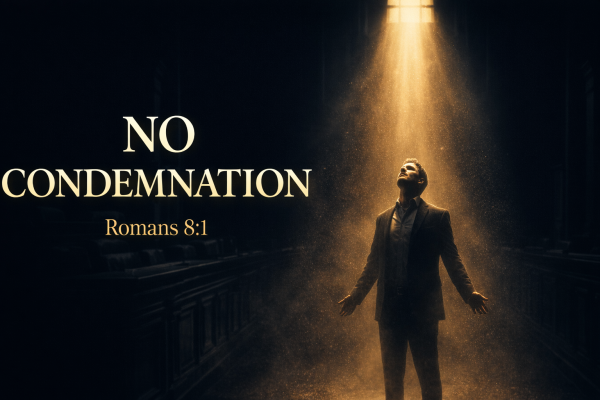
You Are Not Who Your Worst Moment Says You Are
Romans 8:1 | Identity in Christ |
You know what you said. You know how it landed. You replayed it on the drive home, in the shower, at 2 AM when the house was quiet and there was nothing left to distract you from yourself. And somewhere in that silence, the verdict came — not from anyone else, but from inside you: This is who I am. This moment, this failure, this word I cannot take back — this is the truest thing about me.
Maybe it was something you said to someone you love. Maybe it was something you did that you swore you would never do again. Maybe it was simply a pattern that surfaced again — proof, you think, that you have not changed, that you cannot change, that grace applies to everyone else but somehow not to you.
If you have ever sat with that weight, this is written for you.
There is a particular kind of shame that does not just feel bad — it rewrites. It does not say ‘you did a terrible thing.’ It says ‘you are a terrible thing.’ It takes a moment in time and treats it as a revelation — as though your worst hour finally told the truth about you that all your better hours were hiding.
And what makes this so spiritually destabilizing is that it does not feel like a lie. It feels like clarity. Like finally seeing yourself without the flattering light. Like the mask coming off.
But Paul wrote Romans 8 to people who knew exactly what their worst moments felt like. He wrote it to a church that included people who had worshipped idols, who had abandoned community, who had done what they said they would never do. He wrote it not as inspiration but as announcement. He wrote it as a verdict:
“There is therefore now no condemnation for those who are in Christ Jesus.” — Romans 8:1 (ESV)
One word stops everything: therefore. Paul does not begin this declaration in a vacuum. He arrives at it after the brutal honesty of Romans 7 — where he writes about doing the very thing he hates, failing to do the good he wants, being at war with himself. ‘Therefore’ means: after all of that — after the clearest possible accounting of human failure — here is what is true.
Take a moment and read it again. Not as a line to memorize. As a verdict issued over you, today, in this moment, with full knowledge of what you have done.
Peter understood the weight of Romans 8:1 before it was written. He understood it on the beach.
After the resurrection, after the denial — after three public times of saying ‘I do not know the man’ — Jesus did not call a summit. He did not schedule a discipleship review. He made breakfast on the shore. He called Peter by his given name — Simon — which was the name he had before everything changed, before the great promise, before the great failure. He fed him. And then he asked him one question, three times: ‘Do you love me?’
Not: ‘Do you understand what you did?’ Not: ‘Have you learned your lesson?’ Not: ‘Are you sure you’re ready?’ Simply: do you love me? And three times, Peter said yes — and three times, Jesus gave him back his calling. The restoration did not wait for Peter to feel better about himself. It was given while the memory of the denial was still fresh. The new identity did not follow recovery. It preceded it.
Those who have thought deeply about what it means to be known by God have noted that the most stabilizing thing in the Christian life is not knowing God — it is being known by Him. As Packer reflects in Knowing God, the foundation of Christian identity is not our perception of ourselves but God’s knowledge of us — a knowledge that is total, prior, and utterly unshaken by our worst chapters.
Chambers, writing in My Utmost for His Highest, observed that the greatest danger in Christian failure is not the failure itself but what we do with it next — whether we let it become the new lens through which we see everything, or whether we return it to God as the raw material of repentance rather than the new architecture of identity.
And this is exactly what Romans 8:1 is designed to interrupt. Not to minimize the failure. Not to bypass the grief of it. But to refuse to let it speak the last word.
REVEAL CHRIST Jesus does not offer a better self-image. He offers a different verdict. |
Here is what Jesus offers that no amount of therapy, time, or self-improvement can provide:
On the cross, Jesus absorbed the specific shame that the worst-moment voice is using against you. He did not absorb a general category of sin. He absorbed yours — this one, the one you cannot stop replaying, the one that made you wonder if God still knows your name. Stott, in The Cross of Christ, writes carefully and powerfully about the nature of substitutionary atonement: that what happened at Calvary was not symbolic but surgical. Jesus took the precise weight of accusation that would otherwise define you, and he bore it to death.
This means Romans 8:1 is not optimism. It is not a pep talk. It is a legal declaration with the cross as its courtroom and the resurrection as its enforcement. When Paul says ‘no condemnation,’ he means the verdict has already been rendered. The gavel has already fallen. Not in your favor because you are impressive — but in your favor because Jesus is.
Grudem, reflecting on the doctrine of justification in Systematic Theology, is careful to note that justification is not God deciding to overlook the problem — it is God declaring the problem fully addressed in Christ. This means your worst moment has already been taken up into the cross. It does not remain as unpaid debt. It has been discharged.
And right now, as you read this — Jesus is not watching you try to recover. He is at the Father’s right hand, interceding for you. Not hoping things work out. Guaranteeing them. The same Jesus who looked at Peter across the charcoal fire, who already knew what Peter had done, who called him ‘Simon’ with all the tenderness of someone who still saw the rock — he sees you.
You are not who your worst moment says you are. You are who Jesus says you are. And he said it with his life.
What if today you simply sat with Romans 8:1 as a personal verdict rather than a doctrinal statement? Not ‘no condemnation for Christians in general’ — but ‘there is no condemnation for you, right now, as you are, with what you carry.’ Read it as a letter addressed to your name.
You might gently try naming the specific moment — not to rehearse it again, but to bring it explicitly into the space of prayer. To say to God: ‘This is the moment I am afraid defines me. I am bringing it to the cross, not as a bargain, but as a release. I am not carrying this as my identity anymore. Jesus already took it. I am letting him.’
If you are able this week, consider reading John 21 — the breakfast on the shore — slowly. Notice that Jesus does not bring up the denial. Notice that restoration happens in the presence of the wound, not after it has healed. This is the shape of grace: it does not wait for you to feel better. It arrives first.
Some of you are still in the car. Still in the silence after the conversation that changed everything. The shame is still sharp. The replay has not stopped. That is real. The grief of your own worst hour is real, and nothing in this article is asking you to pretend it is not.
And Jesus is real too. Not as a concept — as a person who was crucified and raised, who called a broken fisherman by name on a shoreline, who says the same thing to you that he said to him. There is no condemnation. Not: ‘there will be no condemnation once you have recovered.’ Now. In this moment. Before you feel any better about yourself. Before you have proven anything.
Edwards, reflecting in Religious Affections on the nature of genuine grace, observed that a soul that can grieve its sin without despairing is already showing the marks of a transformed heart — because only someone who has been touched by grace can see their failure clearly and still turn toward God rather than away.
Your worst moment does not have the last word. It never did. That authority belongs to Someone else entirely.
Lord Jesus,
You are the one who knows my name — the name that was spoken before this moment and that will remain after it. I come to you not because I have sorted out how I feel about myself, but because you are the only one whose verdict of me is final. The voice that says this failure is who I am is lying. Your cross already answered it. Help me live today from that answer. Help me not earn what has already been given. I receive, right now, the ‘no condemnation’ you purchased. Not for someone more deserving. For me. Thank you that you do not make me wait until I feel better to call me yours.
Amen.
The cross already answered your worst moment.
COMMUNITY PROMPT
What is the one word from Romans 8:1 that lands most directly in the moment you are currently carrying?
REFERENCES:
Knowing God, J.I. Packer, 1973, pp. 37-44
My Utmost for His Highest, Oswald Chambers, 1935, pp. 12-15
The Cross of Christ, John Stott, 1986, pp. 133-141
Systematic Theology, Wayne Grudem, 1994, pp. 494-502
Religious Affections, Jonathan Edwards, 1746, pp. 197-203